
Quick Answer
A domicile certificate proves your permanent residence in a specific district of Pakistan. You can apply online in Punjab (via Dastak), KPK (via CFC portal), and AJK, or apply in person at your Deputy Commissioner’s office in Sindh and Islamabad. You need your CNIC, photos, residence proof, and an affidavit.
Table of Contents
What Is a Domicile Certificate?
A domicile certificate is an official document that proves you are a permanent resident of a particular district and province in Pakistan. It is issued by the local Deputy Commissioner (DC) or Assistant Commissioner (AC) office.
You need a domicile certificate for several important purposes:
- Applying for government jobs under provincial or federal quotas
- Admission to universities and professional colleges
- Scholarships and educational quotas
- Obtaining a Pakistan Origin Card or other legal documents
Each person can hold only one domicile certificate, tied to a single district. It is issued once and remains valid, though some institutions may ask for a recently attested copy.
Documents Required for a Domicile Certificate
The exact documents required for a domicile certificate vary slightly by province, but the core set is the same across Pakistan. Keep both originals and photocopies ready:
- CNIC or B-Form of the applicant
- CNIC of parents or spouse
- Two passport-size photographs
- Proof of residence — a utility bill (electricity, gas, or water), property papers, or rental agreement
- Educational certificates (Matric and above)
- Affidavit on stamp paper declaring your permanent residence
- Form-B if you have children (Islamabad)

Important
All CNIC addresses should match the district where you are applying. If your CNIC shows a different district, you may need a No Objection Certificate (NOC) from your native district.
How to Apply for a Domicile Certificate Online
Punjab, Khyber Pakhtunkhwa, and Azad Jammu & Kashmir now allow you to apply for a domicile certificate online. Here is how each province works.
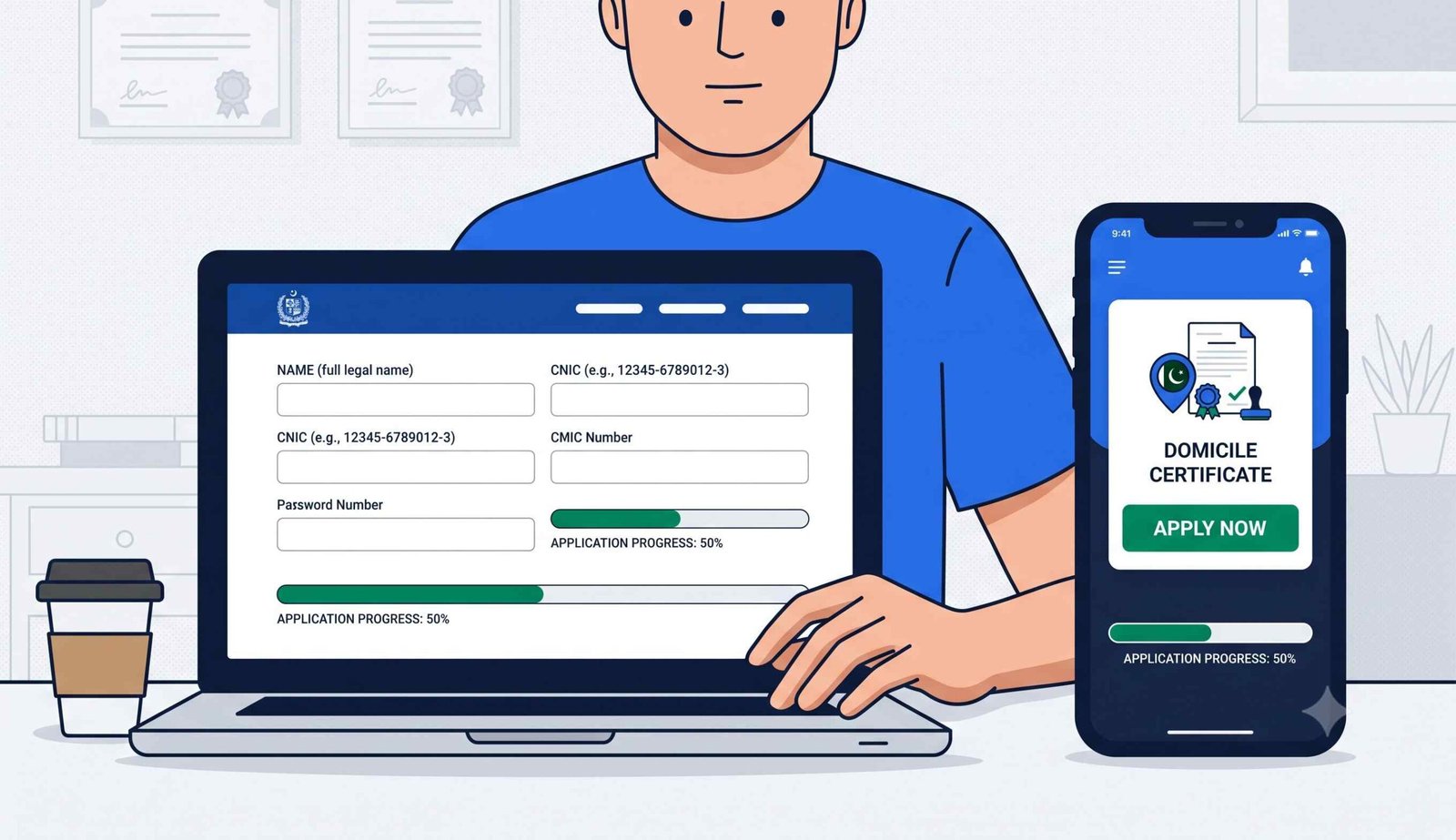
Punjab (Dastak / e-Khidmat)
In Punjab, you can apply through the Dastak citizen portal or the dedicated Domicile Punjab portal.
- Visit the Dastak portal or download the Dastak app
- Register with your CNIC and mobile number
- Select “Domicile Certificate” under Board of Revenue services
- Upload your documents and submit the application
- Use the doorstep delivery service by calling 1202, or collect from your local e-Khidmat Center
You can also verify an issued certificate through the Punjab Domicile Management System.
Khyber Pakhtunkhwa (KPK)
KPK residents apply through the Citizen Facilitation Center (CFC) portal.
- Go to cfc.kp.gov.pk and register with your CNIC
- Log in and select the Domicile Certificate service (DC Office)
- Complete the checklist of required documents and upload them
- Submit your application and track it online
The KPK domicile service is free of charge and issued by the Deputy Commissioner within about 10 working days. For help, call 091-9225484.
Azad Jammu & Kashmir (AJK)
AJK residents can apply online through the e-Facilitation Center (EFC) portal. Register with your CNIC, select the domicile (state subject) service, upload documents, and submit. The service is free and processed within about 10 working days by the Deputy Commissioner.
How to Apply Offline (Sindh & Islamabad)
Sindh and Islamabad currently process domicile certificates in person at the relevant Deputy Commissioner or Assistant Commissioner office.
Sindh
Visit the office of your Deputy Commissioner. For example, Karachi residents apply at the DC office of their district (South, East, West, etc.). The Commissioner Karachi facilitation service processes domicile certificates as follows:
- Pay the domicile fee of Rs. 600
- Submit your original documents for scanning
- Provide your photograph and biometric information
- Collect your certificate within three working days
Make sure all your CNIC addresses match the district where you apply.
Islamabad
In Islamabad, apply in person at the Citizen Facilitation Center, G-11/4, under the ICT Administration.
- Prepare your documents (CNIC at least one year old, parent/spouse CNIC, residence proof, utility bill, Form-B)
- Visit the center between Monday and Thursday (9:00 AM–1:00 PM) or Friday (9:00 AM–12:00 PM)
- Submit your application, get a token, and complete data entry
- Pay the fee of Rs. 1,000 and receive an e-receipt
- Collect your certificate within 7 days (delivery 2:00 PM–3:00 PM)
Islamabad domicile certificates are issued under the Pakistan Citizenship Act (II of 1952). Note that a 50% charge applies for corrections if you provide incorrect information.
Domicile Certificate Fee & Processing Time
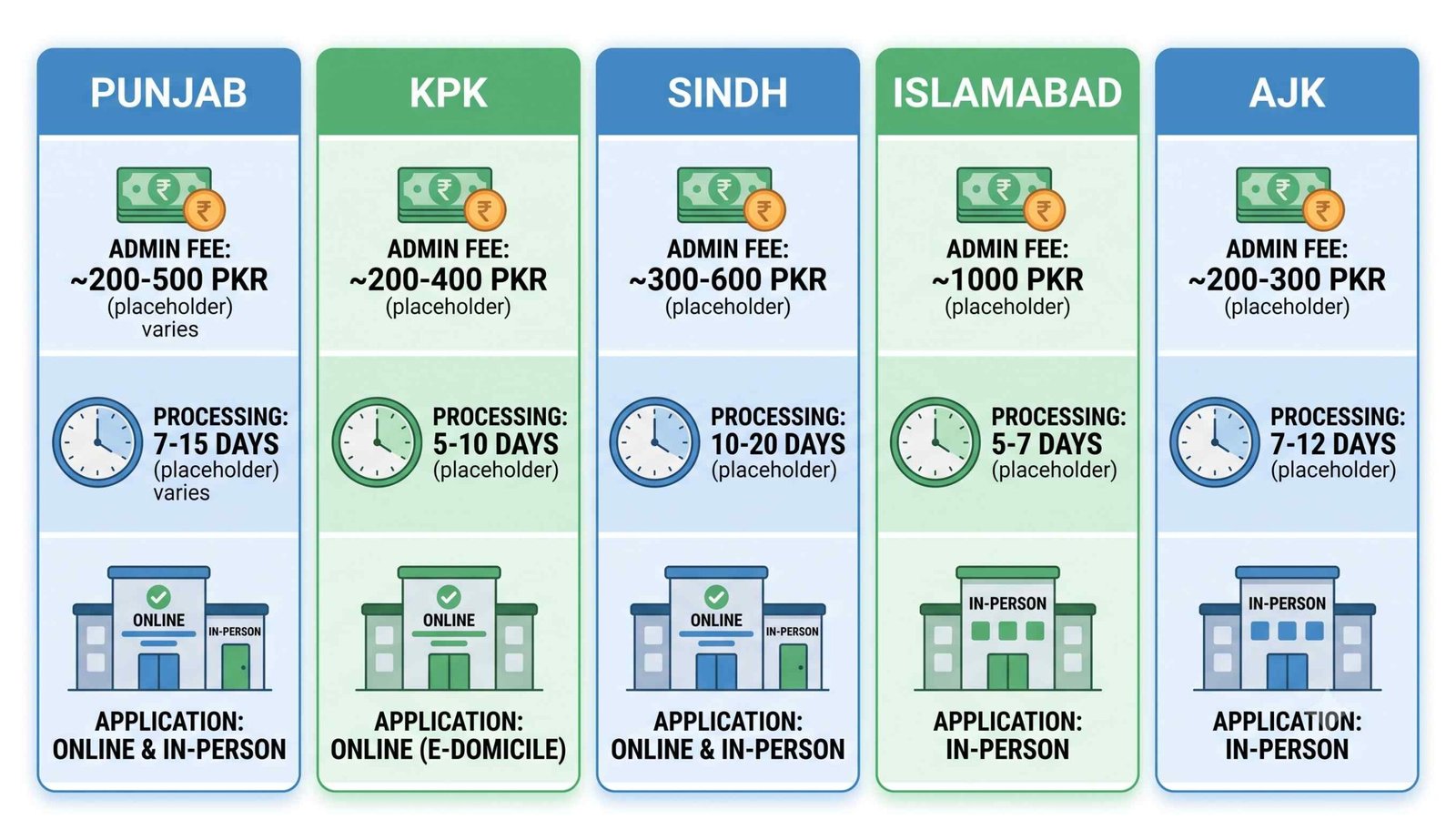
The domicile certificate fee and processing time differ across Pakistan. Here is a province-wise comparison:
| Region | How to Apply | Fee | Processing Time | Issued By |
|---|---|---|---|---|
| Punjab | Online (Dastak) or in person | Rs. 200–300 | ~16 working days | Assistant Commissioner |
| KPK | Online (CFC portal) | Free | 10 working days | Deputy Commissioner |
| Sindh | In person (DC office) | Rs. 600 | 3 working days | Deputy Commissioner |
| Islamabad | In person (CFC G-11/4) | Rs. 1,000 | 7 days | Assistant Commissioner |
| AJK | Online (EFC portal) | Free | 10 working days | Deputy Commissioner |
Does NADRA Issue Domicile Certificates?
No. NADRA does not issue domicile certificates. This is a common misconception. NADRA issues the CNIC, B-Form, and other identity documents, but the domicile certificate is issued by the district administration — the Deputy Commissioner or Assistant Commissioner office of your province.
Your CNIC (issued by NADRA) is a required document when applying for a domicile, but the two are separate. You cannot get a domicile certificate from a NADRA office. If you need help tracking other government documents, see our guide on how to track your passport in Pakistan.
Applying for a government job, college admission, or visa? You will usually need a character certificate along with your domicile — our step-by-step guide explains how to apply and the current fee.
Frequently Asked Questions
How can I apply for a domicile certificate online in Pakistan?
In Punjab, apply through the Dastak portal at dastak.punjab.gov.pk. In KPK, use the CFC portal at cfc.kp.gov.pk. In AJK, use the EFC portal at efc.cdigital.com.pk. Sindh and Islamabad currently require an in-person visit to the DC or AC office.
What documents are required for a domicile certificate?
You need your CNIC or B-Form, parent or spouse CNIC, two passport-size photos, proof of residence (utility bill or property papers), educational certificates, and an affidavit on stamp paper. Requirements vary slightly by province.
How long does it take to get a domicile certificate?
Processing time ranges from 3 working days in Sindh to about 16 working days in Punjab. KPK and AJK take around 10 working days, and Islamabad takes 7 days.
How much does a domicile certificate cost?
Fees vary by region: Punjab charges Rs. 200–300, Sindh Rs. 600, and Islamabad Rs. 1,000. KPK and AJK issue domicile certificates free of charge.
Does NADRA make domicile certificates?
No. NADRA only issues CNIC and identity documents. The domicile certificate is issued by the Deputy Commissioner or Assistant Commissioner of your district, not NADRA.
Can I have more than one domicile certificate?
No. Each Pakistani citizen can hold only one domicile certificate, tied to a single district of permanent residence. Applying for domicile in more than one district is not allowed.
How do I make a domicile certificate online in Punjab?
Register on the Dastak portal (dastak.punjab.gov.pk) or the Domicile Punjab app with your CNIC, select the Domicile Certificate service, upload your documents, and choose doorstep delivery via 1202 or pickup from an e-Khidmat Center.